
8e - FAUBOURG-DU-ROULE
Quartiers Administratifs
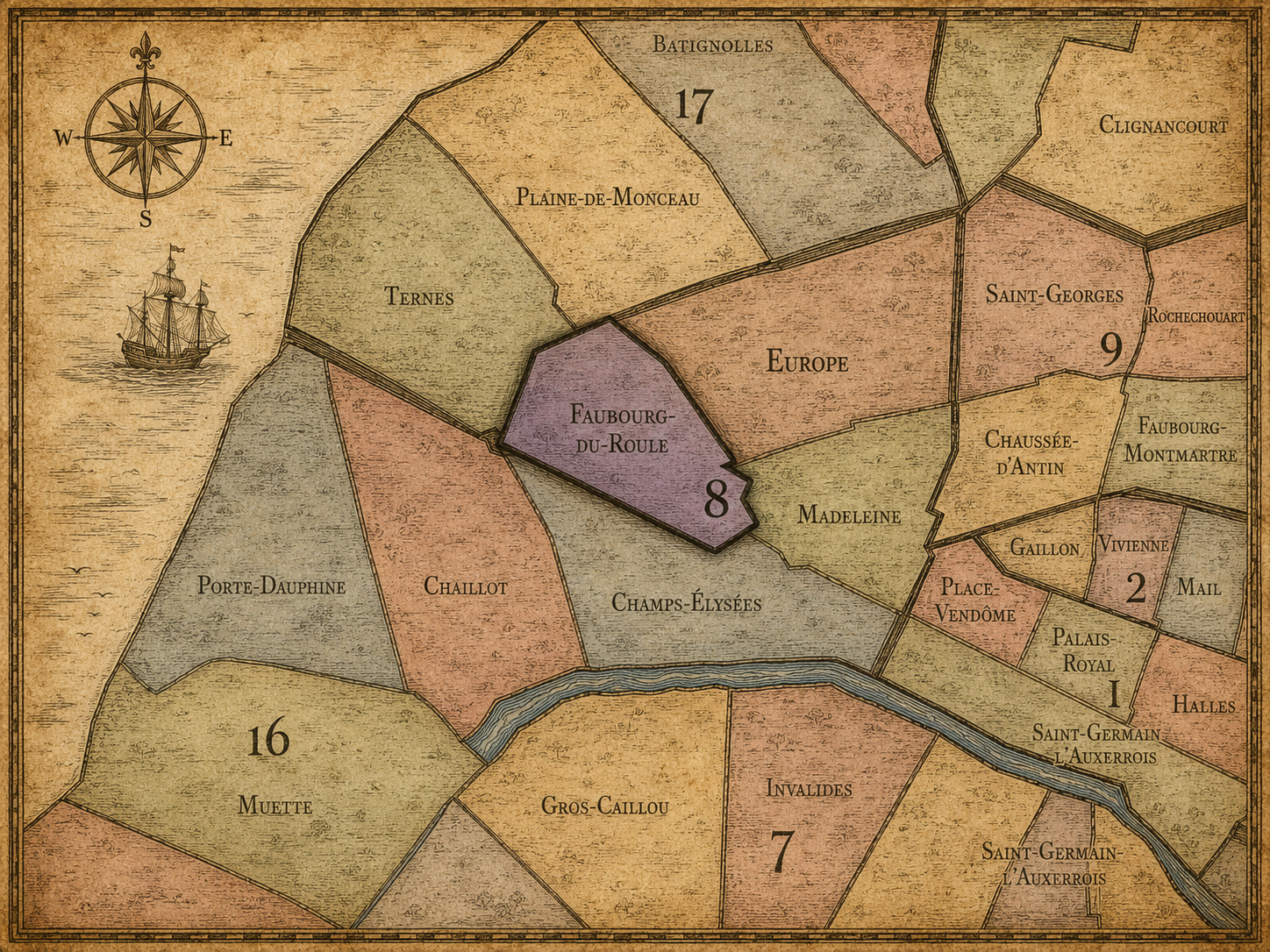
Welcome to the Faubourg-du-Roule neighborhood page! Faubourg-du-Roule is a quartier administratif — the 30th administrative quarter — one of 80 such districts across Paris. As a quartier administratif of the 8e Arrondissement - Élysées, Faubourg-du-Roule belongs to a formal layer of Parisian geography and extends around Rue du Faubourg-Saint-Honoré, Parc Monceau, and the approaches to the Arc de Triomphe. Faubourg-du-Roule carries a refined mix of diplomatic, commercial, residential, and luxury Paris.
Part of an ongoing project to walk and photograph every neighborhood in Paris, this page explores 8e Faubourg-du-Roule through maps, district identity, history, and photography.
The Map
Geographic Setting
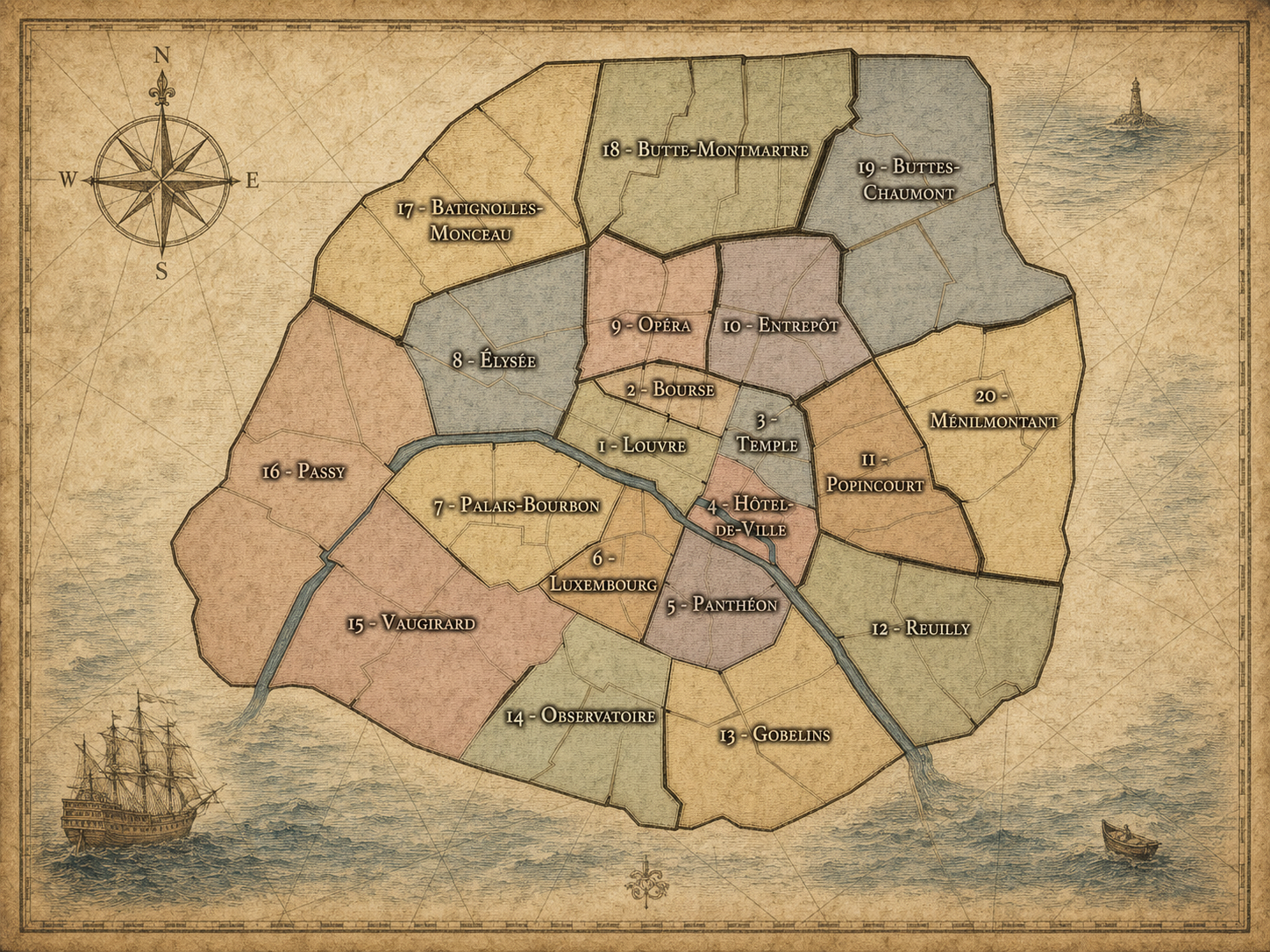
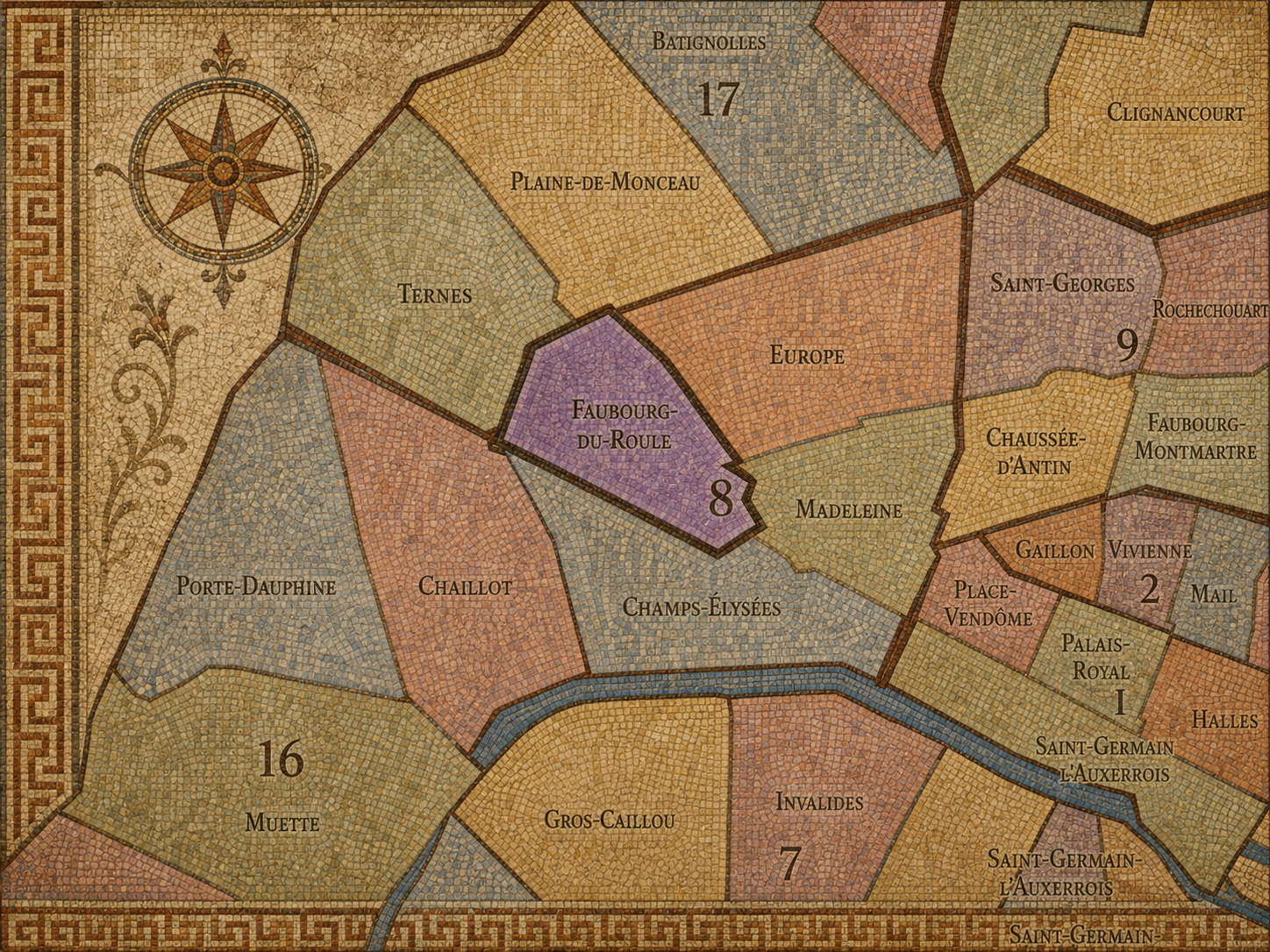
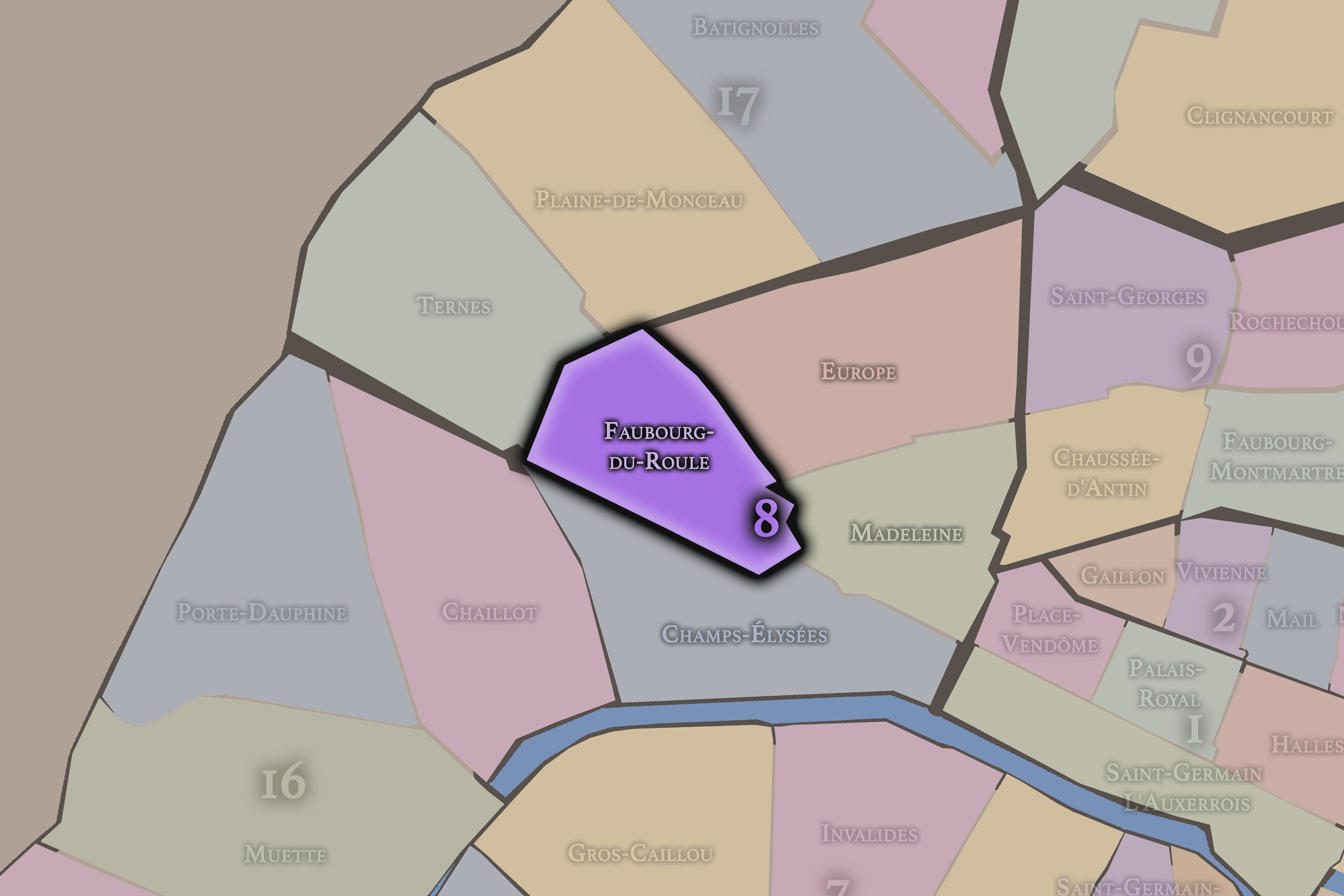
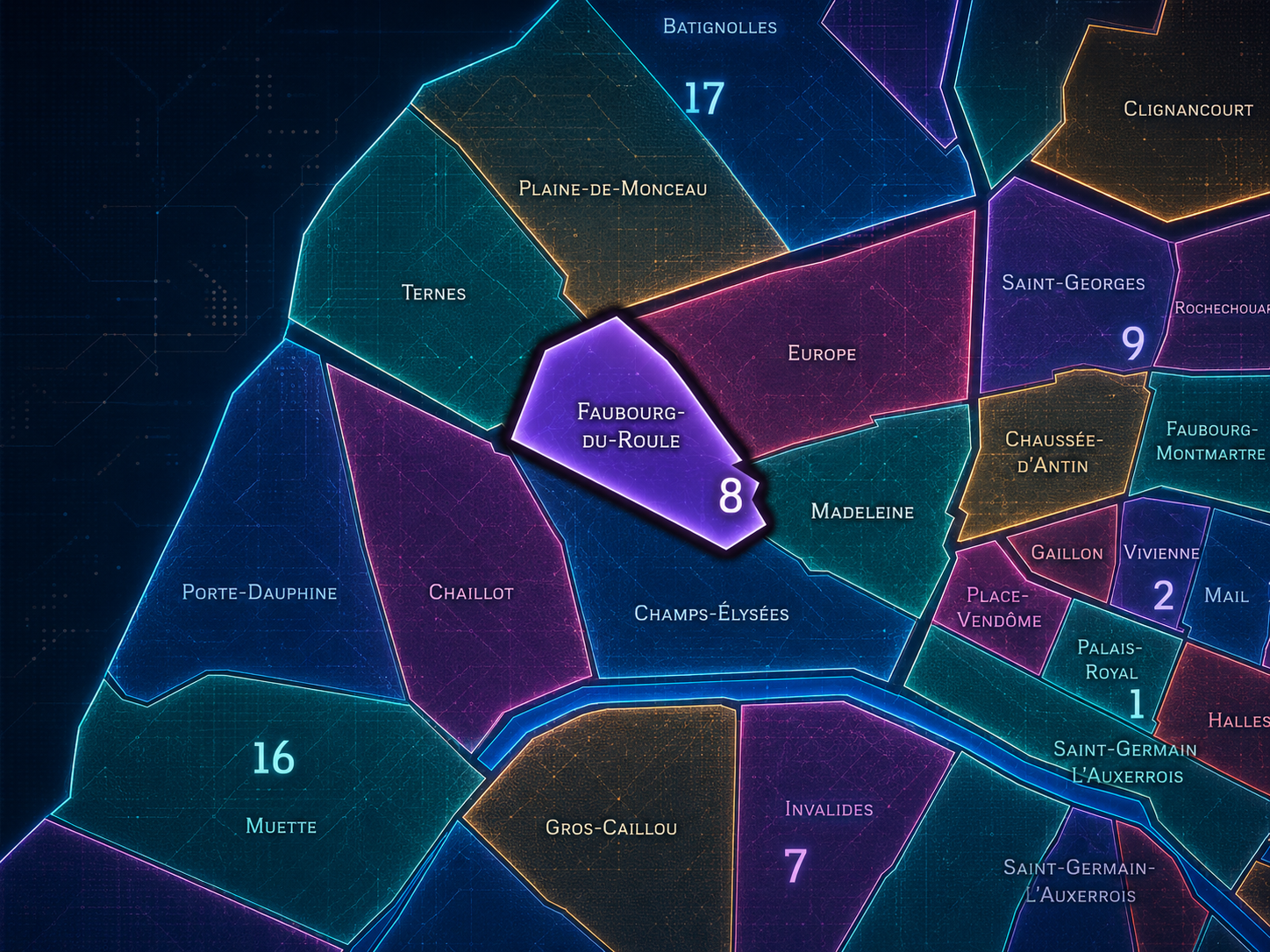
Faubourg-du-Roule occupies the north-central and western interior of the 8th arrondissement, where the prestige corridors around the upper Champs-Élysées meet the residential, diplomatic, commercial, and institutional streets that lead toward Monceau, Ternes, and the western expansion of Paris. It lies east of the Arc de Triomphe and north of the Champs-Élysées quarter, west of Madeleine, and southwest of Europe, forming a transitional landscape between ceremonial Paris, bourgeois residential Paris, and the older roadways leading out from the city.
The quarter’s geography is shaped by streets such as Rue du Faubourg-Saint-Honoré, Avenue de Friedland, Boulevard Haussmann, Rue de Courcelles, Rue de Berri, Rue de Washington, Rue La Boétie, and the approaches to Parc Monceau and Place Charles-de-Gaulle. It is not as singularly theatrical as the Champs-Élysées, nor as railway-driven as Europe, nor as church-and-luxury centered as Madeleine. Faubourg-du-Roule is more layered and connective: a quarter of embassies, offices, residences, galleries, hôtels particuliers, commercial streets, and prestigious addresses woven into the upper Right Bank.
This is a quarter where Parisian grandeur becomes less ceremonial and more lived through address. Its streets are wide enough to feel formal, but not always monumental. Its buildings often carry the restrained wealth of the 19th-century bourgeois city. It is a neighborhood of proximity — near the Champs-Élysées, near Parc Monceau, near Saint-Honoré, near the Arc — yet it holds its own identity as one of the 8th arrondissement’s quieter landscapes of influence.
Administrative Quarter Identity
Etymology and Origins
The name Faubourg-du-Roule comes from the old faubourg of Le Roule, a settlement and road district that developed outside the earlier limits of Paris along the route leading westward from the city. The word faubourg means a suburb or district beyond the walls, historically referring to areas that grew outside the fortified city but remained tied to it through roads, gates, trade, and gradual urban expansion. “Roule” preserves the older local name that became attached to the church, streets, and later administrative quarter.
This makes Faubourg-du-Roule one of the 8th arrondissement’s names of expansion. It does not begin as a grand avenue, a monumental square, or a railway-era plan. It begins as a place beyond — a road settlement on the edge of Paris, gradually drawn inward as the city grew westward. Its name remembers the time when this now-prestigious district was part of the outer geography of the capital.
The quarter’s identity therefore rests on transformation. What was once faubourg became central. What was once approach became address. The old road westward became one of the capital’s most prestigious urban corridors. Faubourg-du-Roule carries the memory of Paris expanding beyond itself and then turning that former edge into one of its landscapes of rank, residence, and influence.
Civic Framework
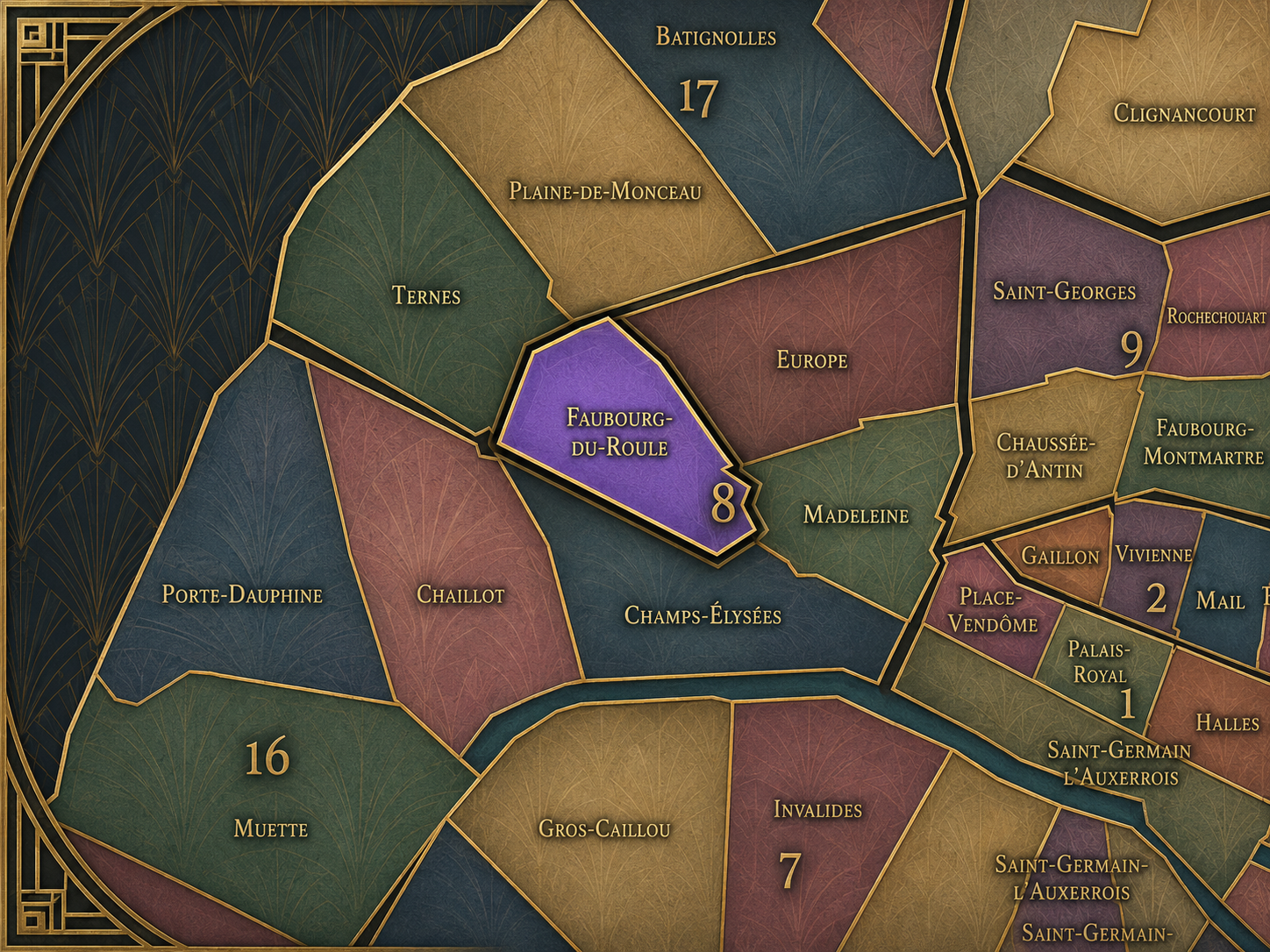
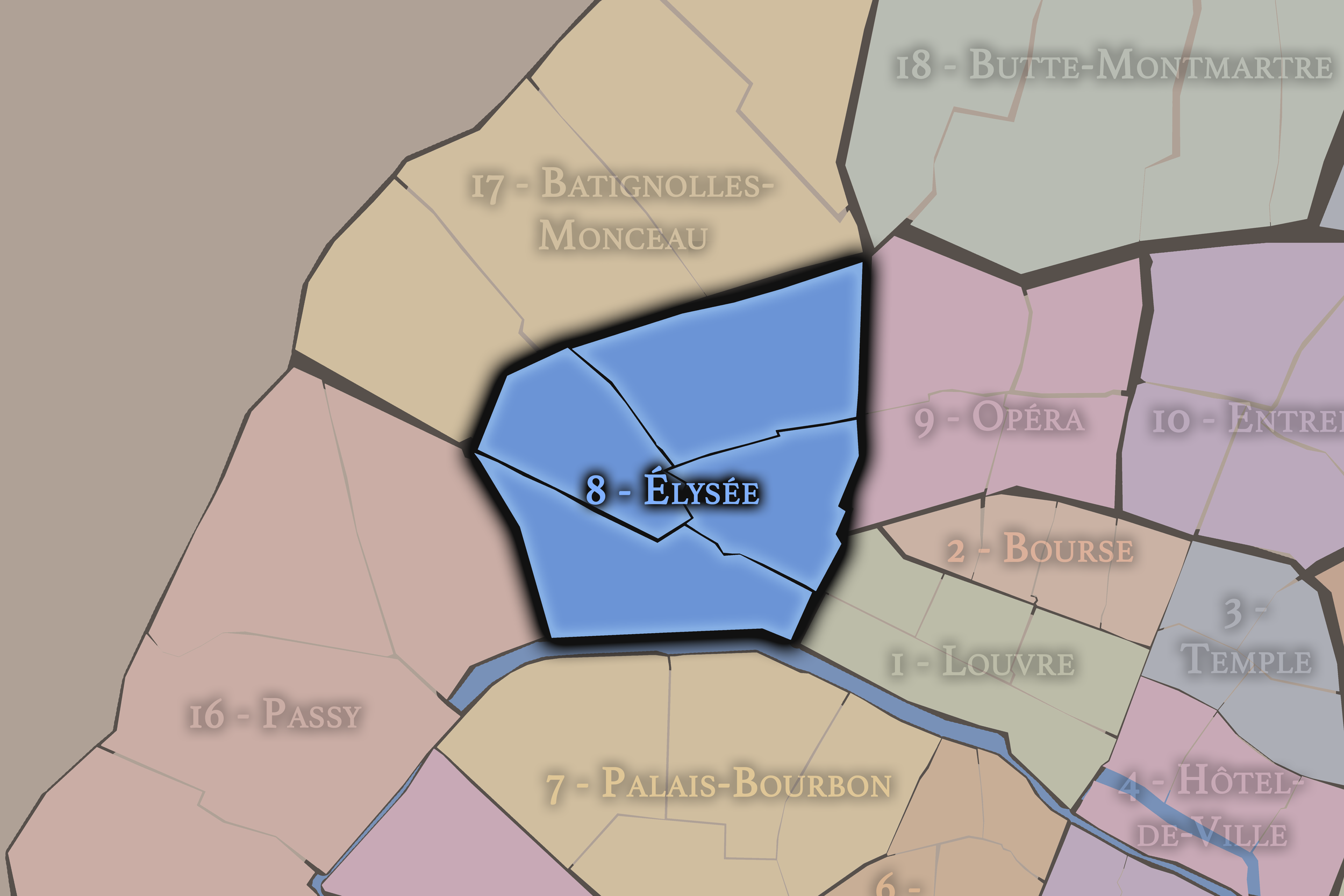
Within the official geography of Paris, Faubourg-du-Roule is one of the four administrative quarters of the 8th arrondissement, alongside Champs-Élysées, Madeleine, and Europe. It occupies the arrondissement’s northwestern and interior sector, forming a bridge between the ceremonial axis of the Champs-Élysées, the railway and residential structure of Europe, and the formal luxury and institutional landscapes around Madeleine.
As an administrative quarter, Faubourg-du-Roule gives civic shape to an area that can otherwise be described through surrounding names: upper Champs-Élysées, Saint-Honoré, Monceau edge, Friedland, Courcelles, or the western 8th. The official quarter name restores the older faubourg identity beneath these more modern or prestigious references. It reminds us that the 8th arrondissement is not only a district of monuments and luxury, but also a record of Paris’s westward growth.
This civic frame is especially useful because Faubourg-du-Roule contains several overlapping Parisian systems. It is residential and commercial, local and diplomatic, historic and modern, adjacent to global tourism but often removed from its heaviest flows. The administrative quarter gathers these relationships into one mapped unit, allowing the district to be read as more than the backdrop to the Champs-Élysées.
Neighborhood Distinction
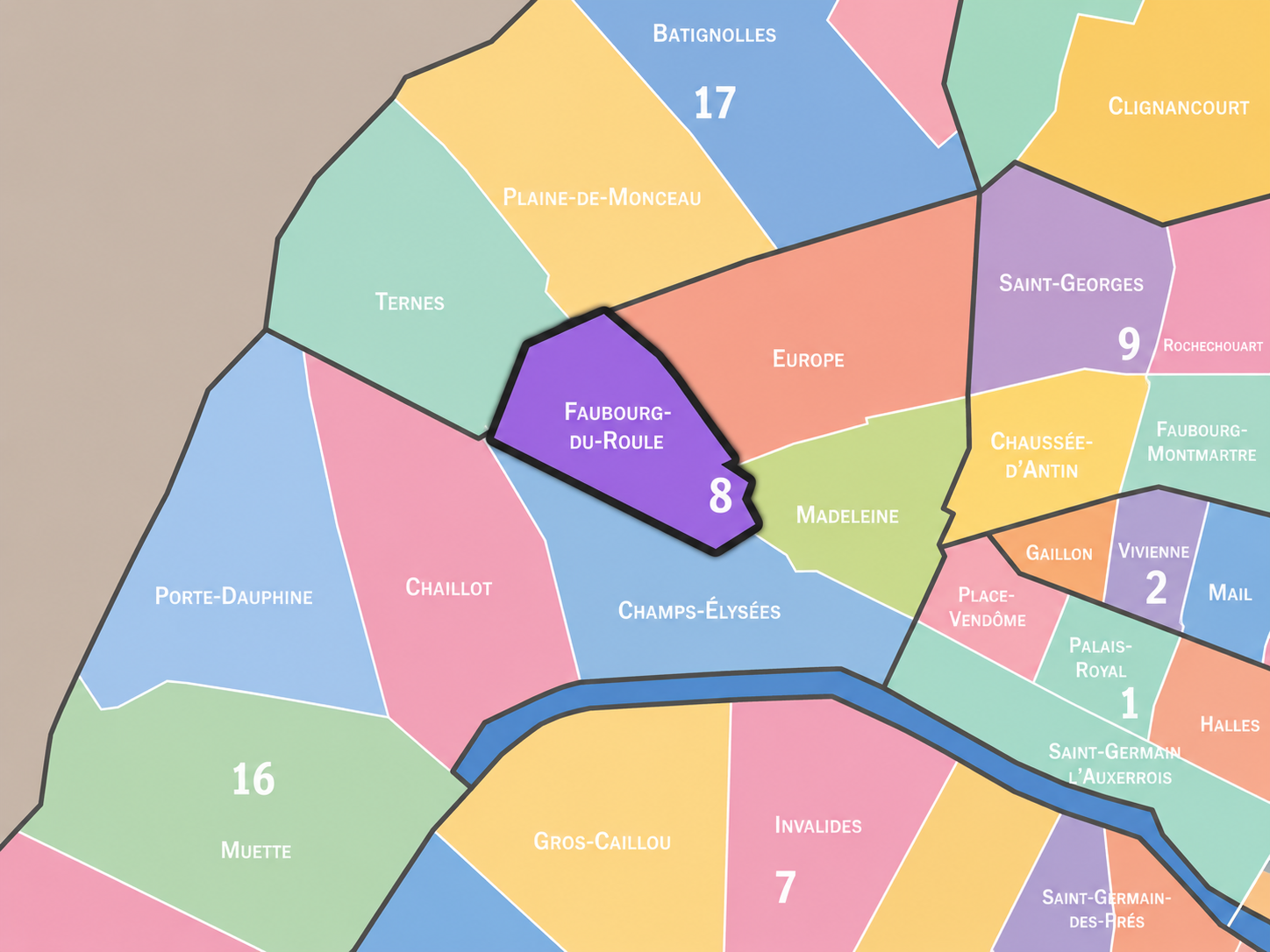
Faubourg-du-Roule differs from the other quarters of the 8th arrondissement through its role as a transitional prestige district. Champs-Élysées is the arrondissement’s great ceremonial and commercial stage, shaped by axis, monument, tourism, and national display. Madeleine is more compactly formal, tied to church, luxury food, the Opéra-Concorde edge, and the refined corridors around Boulevard Malesherbes and Rue Royale. Europe is infrastructural and residential, organized by Saint-Lazare, railway cuts, bridges, and streets named for European cities.
Faubourg-du-Roule is less dominated by one landmark or one function. Its identity comes from urban fabric: prestigious streets, upper-bourgeois apartment buildings, embassies, galleries, offices, private residences, and corridors leading between the Arc de Triomphe, Parc Monceau, Saint-Honoré, and the Champs-Élysées. It is the 8th arrondissement as address rather than icon.
It should also be distinguished from the Champs-Élysées itself. The two are adjacent and historically connected, but their atmospheres differ. Champs-Élysées is public spectacle. Faubourg-du-Roule is quieter prestige. Champs-Élysées gathers crowds and images; Faubourg-du-Roule absorbs the surrounding power into streets of residence, work, diplomacy, and commercial refinement.
Parisian Identity
Faubourg-du-Roule expresses Paris as a city of outward expansion turned into social geography. Its identity is not simply monumental, but metropolitan: the old western road, the former faubourg, the 19th-century avenues, the residential prestige of the upper Right Bank, the proximity to power and commerce, and the continued importance of address. The quarter is Paris as growth refined into order.
This is one of the places where the city’s westward movement becomes visible. Paris did not always center its elite life where it does now. Over centuries, the capital expanded beyond the medieval and early modern core, and western districts gained increasing prestige through royal planning, aristocratic movement, bourgeois development, and Haussmannian transformation. Faubourg-du-Roule carries that history in its very name: a suburb now fully absorbed into the capital’s high-status center.
The quarter’s Parisian identity is also defined by controlled visibility. It is close to some of the most famous spaces in the world, but its own character is more restrained. It does not need a single overwhelming monument. Its meaning lies in networks of influence: embassies, firms, galleries, residences, luxury-adjacent streets, and the subtle forms of power that gather near but not necessarily on the avenue.
Neighborhood Connections
Every neighborhood belongs to a wider Parisian fabric.
-
8e — Élysée
-
Hoche-Friedland
-
Monceau
-
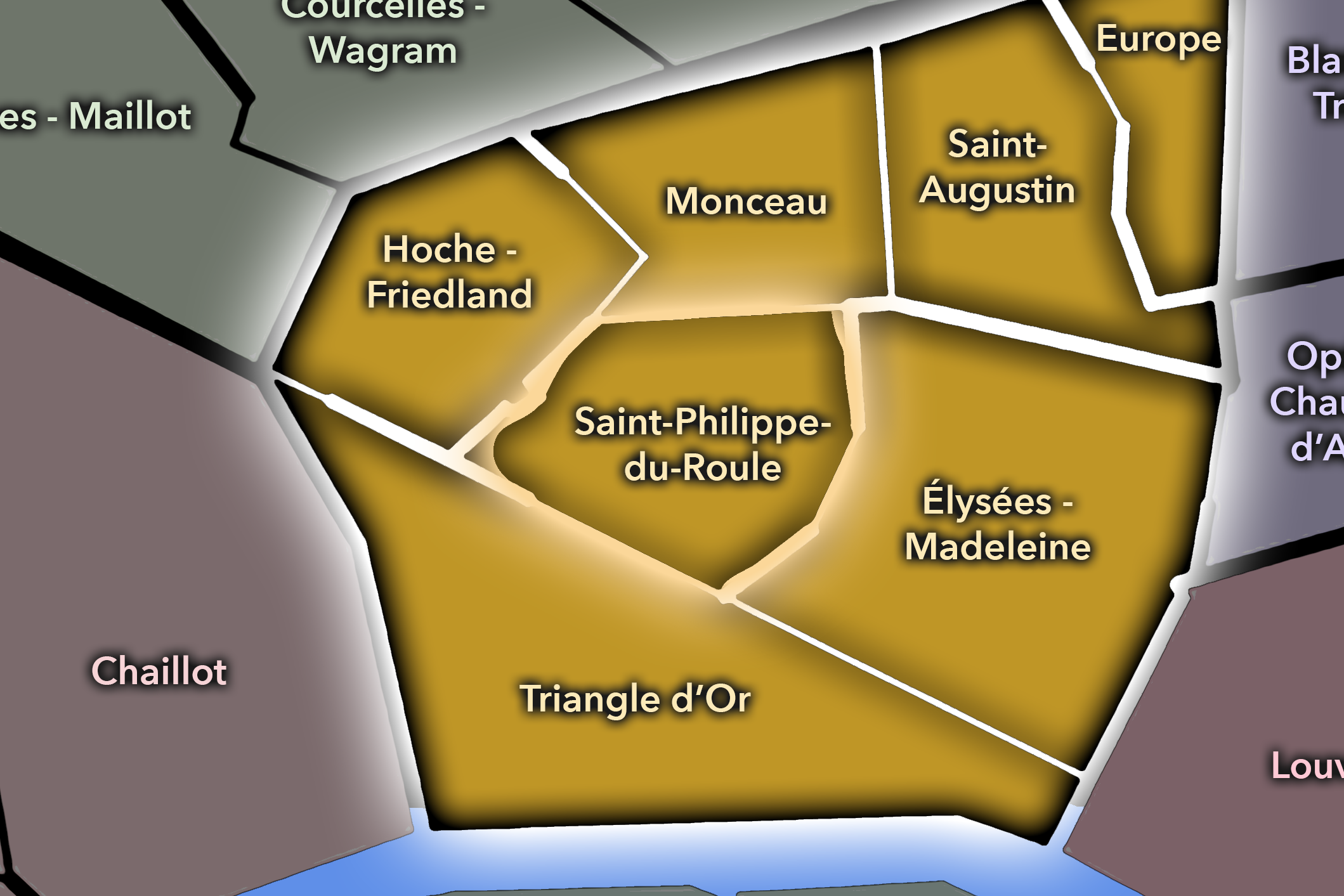
Saint-Philippe du Roule
-
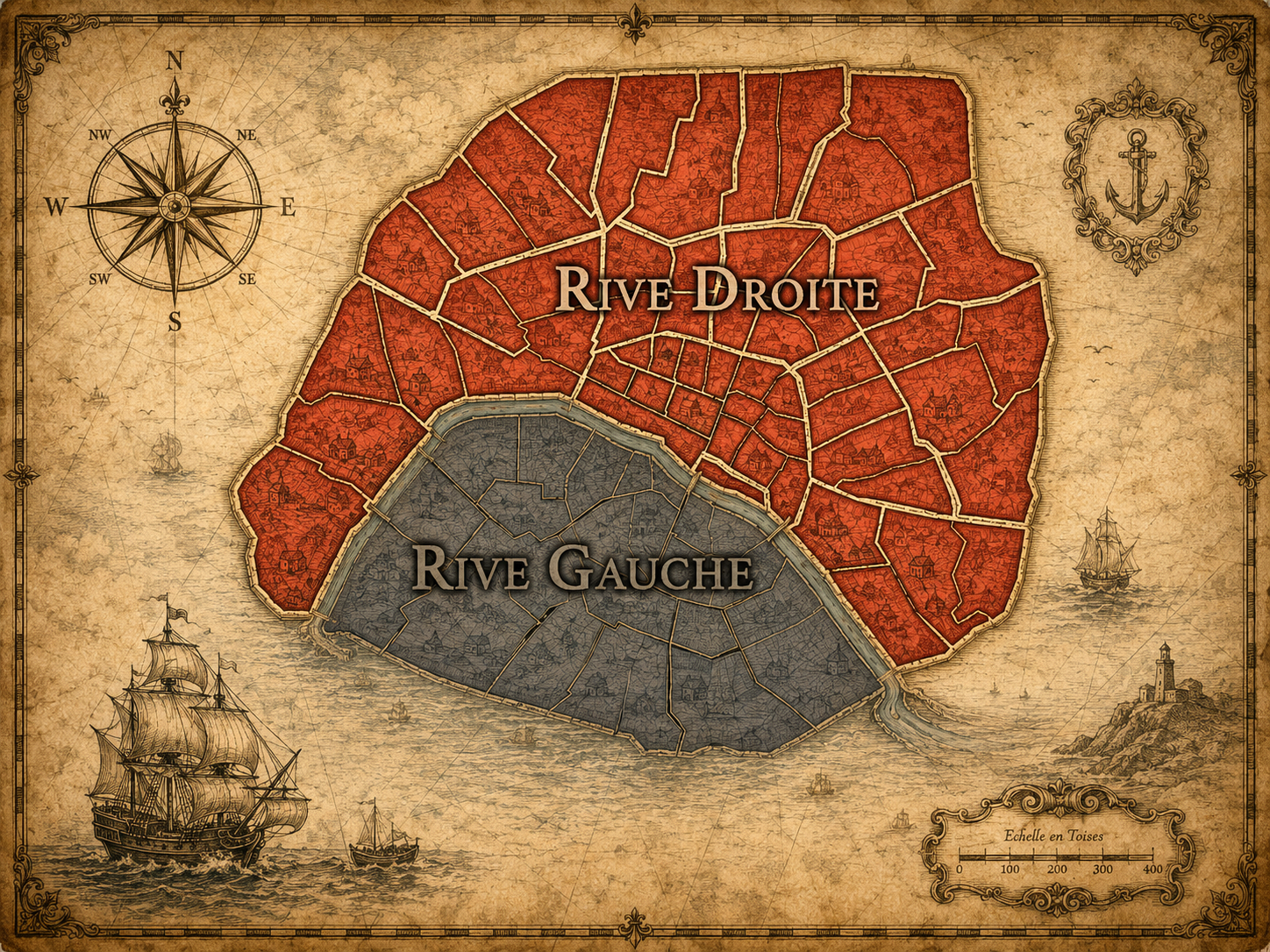
Rive Droite
The History
Origins
The origins of Faubourg-du-Roule lie outside the old city, along routes leading westward from Paris. Before the district became part of the formal 8th arrondissement, Le Roule existed as a settlement and road landscape beyond the denser city. Like many faubourgs, it developed through movement: people, carts, goods, travelers, and local life gathered along the roadway connecting Paris to the lands beyond.
The area’s early identity was therefore less urban than transitional. It belonged to the outer belt of villages, religious houses, gardens, and road communities that surrounded Paris before the city absorbed them. The later prestige of the quarter can obscure this origin, but the name preserves it clearly. Faubourg-du-Roule was once a place at the edge.
That edge condition shaped its future. Because it lay outside the densest older city, the district had room to be reorganized as Paris expanded westward. Roadside growth became suburb; suburb became urban quarter; urban quarter became one of the prestigious interiors of the modern 8th arrondissement.
16th–17th Century
In the 16th and 17th centuries, the future Faubourg-du-Roule remained outside the main urban fabric of Paris, associated with the roads and lands beyond the city’s western limits. The area retained a semi-rural and suburban character, with scattered settlement, fields, religious properties, and routes connecting the city to the surrounding countryside.
This was the period when the western side of Paris began to acquire increasing importance through royal and aristocratic movement. The Tuileries, the Champs-Élysées axis, and the growth of elite western landscapes gradually changed the meaning of the areas beyond the old center. Le Roule was still peripheral, but the direction of Parisian prestige was beginning to move westward.
By the end of the 17th century, the conditions for transformation were in place. The old faubourg would not remain an outer settlement forever. As Paris stretched along new axes and toward new residential districts, Faubourg-du-Roule began the long passage from roadside edge to urban address.
18th Century
In the 18th century, Faubourg-du-Roule became increasingly integrated into the expanding western city. The development of the Champs-Élysées, the Faubourg Saint-Honoré, and the growing prestige of western Paris pulled the old road district closer to the life of the capital. What had once been peripheral became desirable, especially as aristocratic and bourgeois residences began to spread into the surrounding area.
The quarter’s church and local institutions helped anchor the old faubourg identity as urbanization advanced. Streets, houses, gardens, and estates filled in the landscape, while the road toward the west became part of a more formal and socially elevated urban geography. The district began to stand between older village-like memory and the new Paris of prestige development.
The French Revolution disrupted the social order that had shaped western Paris, but it did not reverse the area’s urban importance. Former aristocratic landscapes, religious properties, and suburban settlements were reorganized within a new civic and political framework. Faubourg-du-Roule entered the modern era no longer simply as an outer district, but as part of the expanding capital.
19th Century
The 19th century gave Faubourg-du-Roule much of its modern character. As Paris expanded westward and the 8th arrondissement took shape as a district of prestige, commerce, residence, and ceremony, the old faubourg became fully absorbed into the city’s metropolitan structure. Haussmannian planning, broad avenues, bourgeois apartment buildings, private mansions, and commercial corridors transformed the district into one of the refined landscapes of the modern Right Bank.
Avenue de Friedland, Boulevard Haussmann, Rue La Boétie, Rue de Courcelles, and nearby streets contributed to the quarter’s new urban order. The proximity of the Arc de Triomphe, the Champs-Élysées, Parc Monceau, and the Faubourg Saint-Honoré made the district a natural setting for high-status residence and business. It became a place for those who wanted proximity to power and spectacle without living directly inside the crowd.
The 19th century also solidified the distinction between the old faubourg name and the new urban reality. Faubourg-du-Roule still carried the memory of an outer settlement, but its streets now belonged to the capital’s prestigious west. This tension — old edge, new center — remains one of the quarter’s defining features.
Early–Mid 20th Century
In the early and mid 20th century, Faubourg-du-Roule continued to function as a district of high-status residence, commerce, offices, and diplomatic presence. Its proximity to the Champs-Élysées and the Arc de Triomphe connected it to the public image of Paris, while its interior streets retained a more controlled and residential atmosphere. The quarter was prestigious, but less publicly theatrical than the avenue itself.
The area’s buildings housed businesses, families, embassies, professional offices, galleries, and institutions. It was part of the western Paris that became increasingly associated with wealth, international connections, and the formal life of the modern capital. The quarter’s older faubourg identity was still present in name, but the lived district had become fully metropolitan.
During the upheavals of war, occupation, liberation, and postwar recovery, the quarter’s proximity to major symbolic and diplomatic spaces gave it a particular importance. Like much of the 8th arrondissement, Faubourg-du-Roule belonged to a Paris where politics, commerce, diplomacy, and prestige were closely intertwined behind elegant façades.
Late 20th Century
In the late 20th century, Faubourg-du-Roule became increasingly shaped by offices, international business, luxury-adjacent commerce, galleries, embassies, and high-value residential life. The quarter’s location near the Champs-Élysées and Faubourg Saint-Honoré made it attractive to corporate, diplomatic, and commercial uses, while its residential streets retained an atmosphere of discreet affluence.
This period also brought the pressures common to prestigious central districts. Rising real estate values, the expansion of office use, tourism spillover, and the transformation of older retail patterns altered the balance between local life and metropolitan function. Faubourg-du-Roule remained elegant, but its identity became more professional and international.
At the same time, the quarter preserved a strong architectural coherence. Haussmannian façades, hôtels particuliers, embassy buildings, and restrained streetscape gave the district continuity even as uses changed. Faubourg-du-Roule became one of the places where the modern economy occupied a 19th-century urban shell.
21st Century
In the 21st century, Faubourg-du-Roule remains one of the 8th arrondissement’s most important districts of prestige, residence, diplomacy, and business. It sits close to some of the most visited spaces in Paris, but its own streets often feel more reserved: polished, guarded, expensive, and quietly active. The quarter is crossed by workers, residents, visitors, shoppers, diplomats, and people moving between the Champs-Élysées, Parc Monceau, Saint-Honoré, and Saint-Lazare.
Today, the quarter’s identity lies in the balance between centrality and discretion. It is not hidden, but it is not primarily a tourist district. It is not purely residential, but residence remains part of its character. It is commercial and professional, but its streets still carry the memory of an older faubourg absorbed into western Paris. Faubourg-du-Roule remains a place where movement outward from the old city has been converted into address, influence, and urban polish.
For CityNeighborhoods: Paris, Faubourg-du-Roule is essential because it shows how neighborhood identity can be made from absorption. The old suburban road district has not disappeared. It survives beneath the business addresses, embassy façades, apartment buildings, and prestige corridors of the modern 8th. The quarter reveals Paris not as fixed center and edge, but as a city whose edges repeatedly become centers.
Spirit and Legacy
Faubourg-du-Roule is the quarter of the former edge made elegant. Its spirit is transitional, polished, and quietly influential. It belongs to roads that became streets, suburbs that became central, façades that conceal networks of power, and addresses that carry more weight than their understated appearance might suggest.
Its legacy is westward movement. A faubourg beyond the old city became part of the capital’s prestige geography. Roadside settlement became metropolitan quarter. Proximity to the Champs-Élysées, Saint-Honoré, Parc Monceau, and the Arc de Triomphe gave the district new forms of value, while its older name continued to preserve the memory of growth.
To walk Faubourg-du-Roule is to encounter Paris in the act of having expanded. The quarter does not offer one simple monument or myth. It offers the urban evidence of transition: old route, modern avenue, residence, office, embassy, gallery, and discreet prestige layered together. In Faubourg-du-Roule, neighborhood identity is not announced by spectacle. It is carried by address — and by the long memory of a road that became part of the city.
The Photography
Visual Identity
-
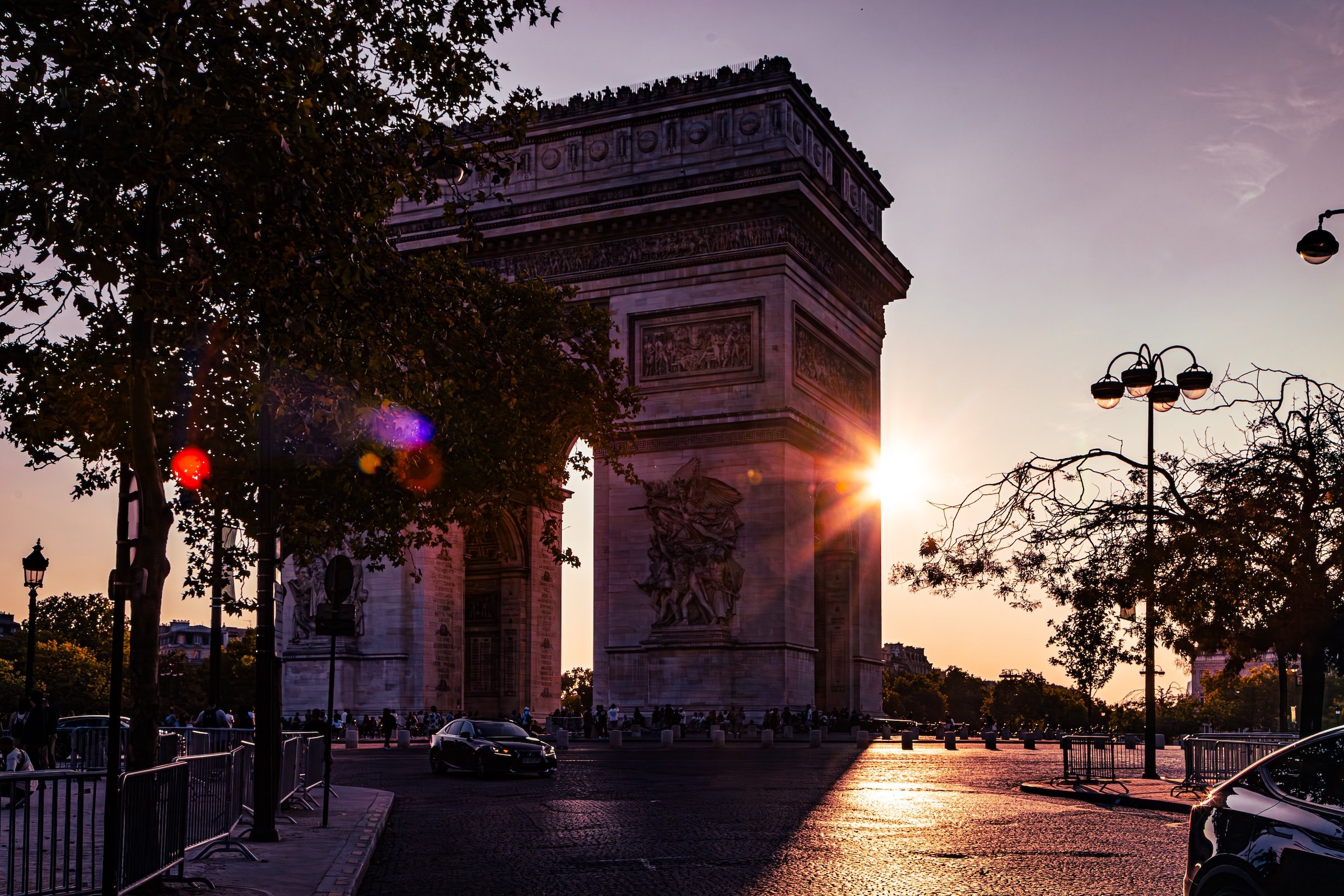
Faubourg du Roule’s visual identity, as encountered on this first evening, is defined by proximity to the Arc de Triomphe and the ceremonial geography of the western Right Bank. At the edge of Place Charles de Gaulle, the quarter participates in the visual grandeur of radiating avenues, formal façades, traffic, stone, and monument. It does not separate easily from the Arc in this brief passage; instead, it functions as one of the viewing positions through which the monument is approached, circled, and understood.
The quarter’s impression is therefore elegant but incomplete — a visual prelude rather than a full portrait. Its relationship to the Champs-Élysées, Avenue de Friedland, and the great western avenues gives it an air of prestige, alignment, and urban polish. On August 15, it photographed as part of the city’s formal machinery: Paris arranged for arrival, movement, and display. The deeper residential and commercial textures of Faubourg du Roule remained for another walk, but its first visual identity was unmistakably tied to grandeur, orientation, and the architecture of approach.
Through The Lens
-
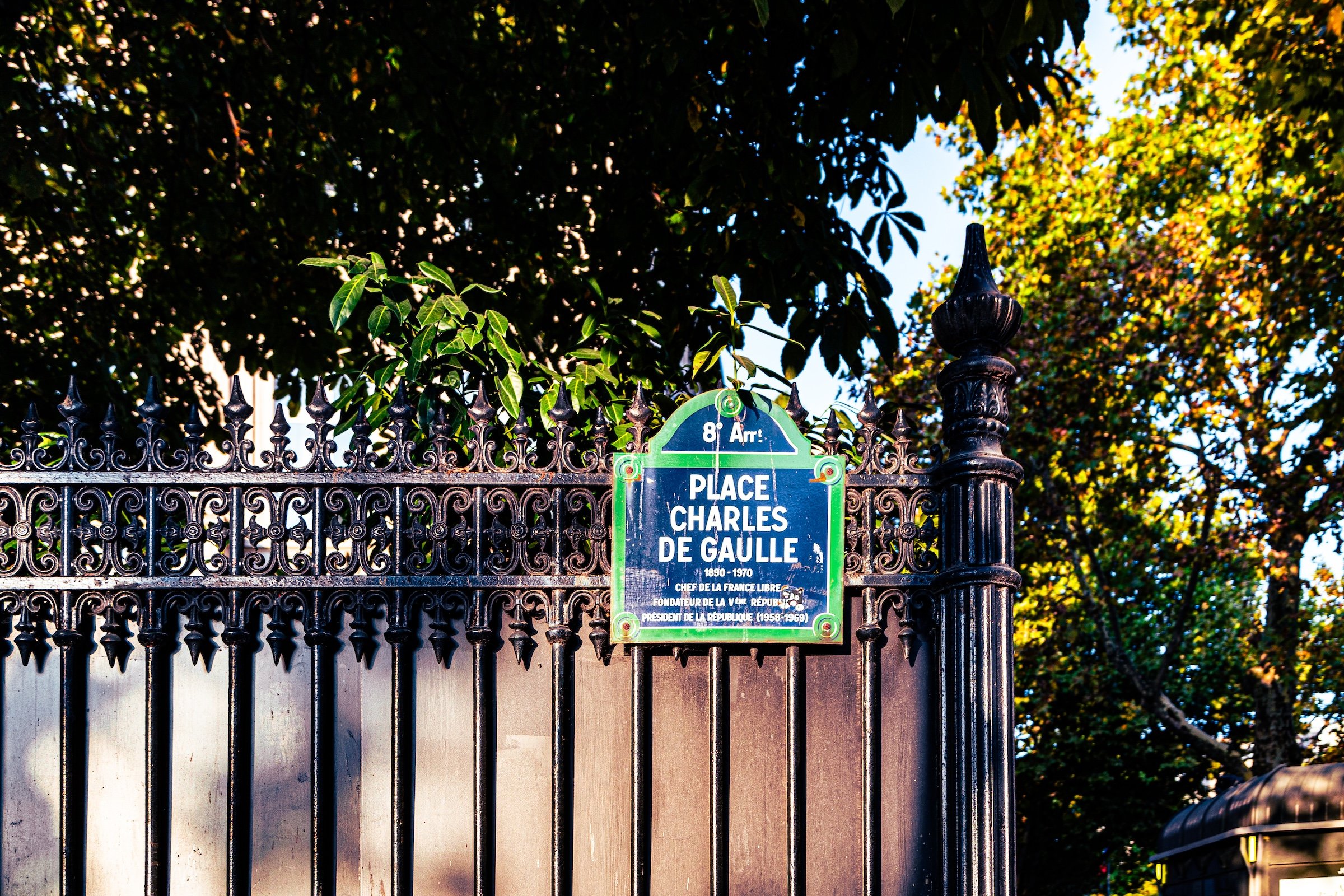
Faubourg du Roule photographed as proximity: proximity to the Arc, to the Champs-Élysées, to the visual language of prestige and arrival. The images are shaped by the monument’s pull, with the district functioning almost as a viewing position.
For that reason, the photographs feel like notes rather than conclusions. They capture the district at the edge of spectacle — elegant, formal, and still largely undiscovered beyond its relationship to the Arc. It is a photographic promise rather than a finished portrait.
If you visit Paris, these ideas can help inspire your own photography.
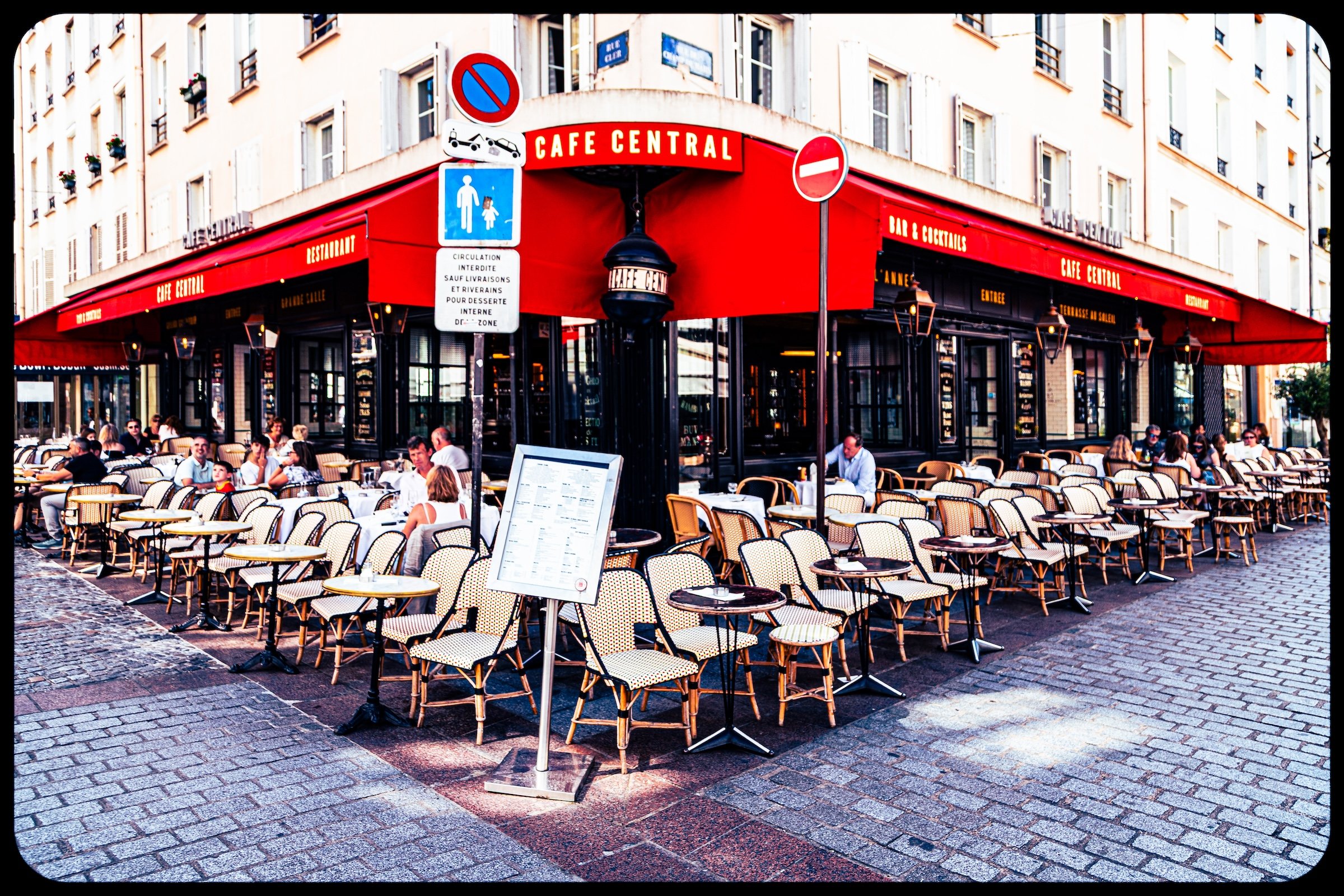
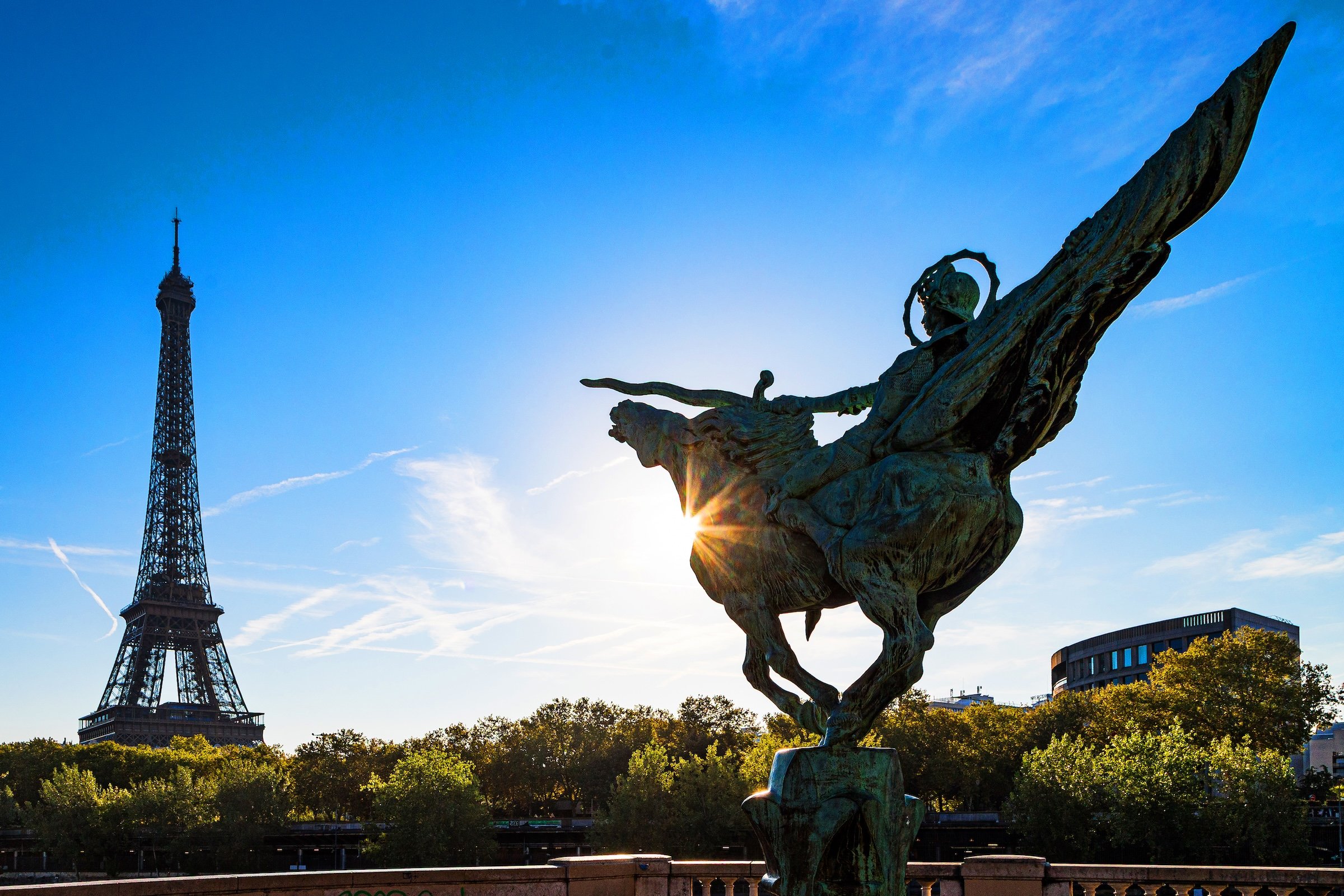
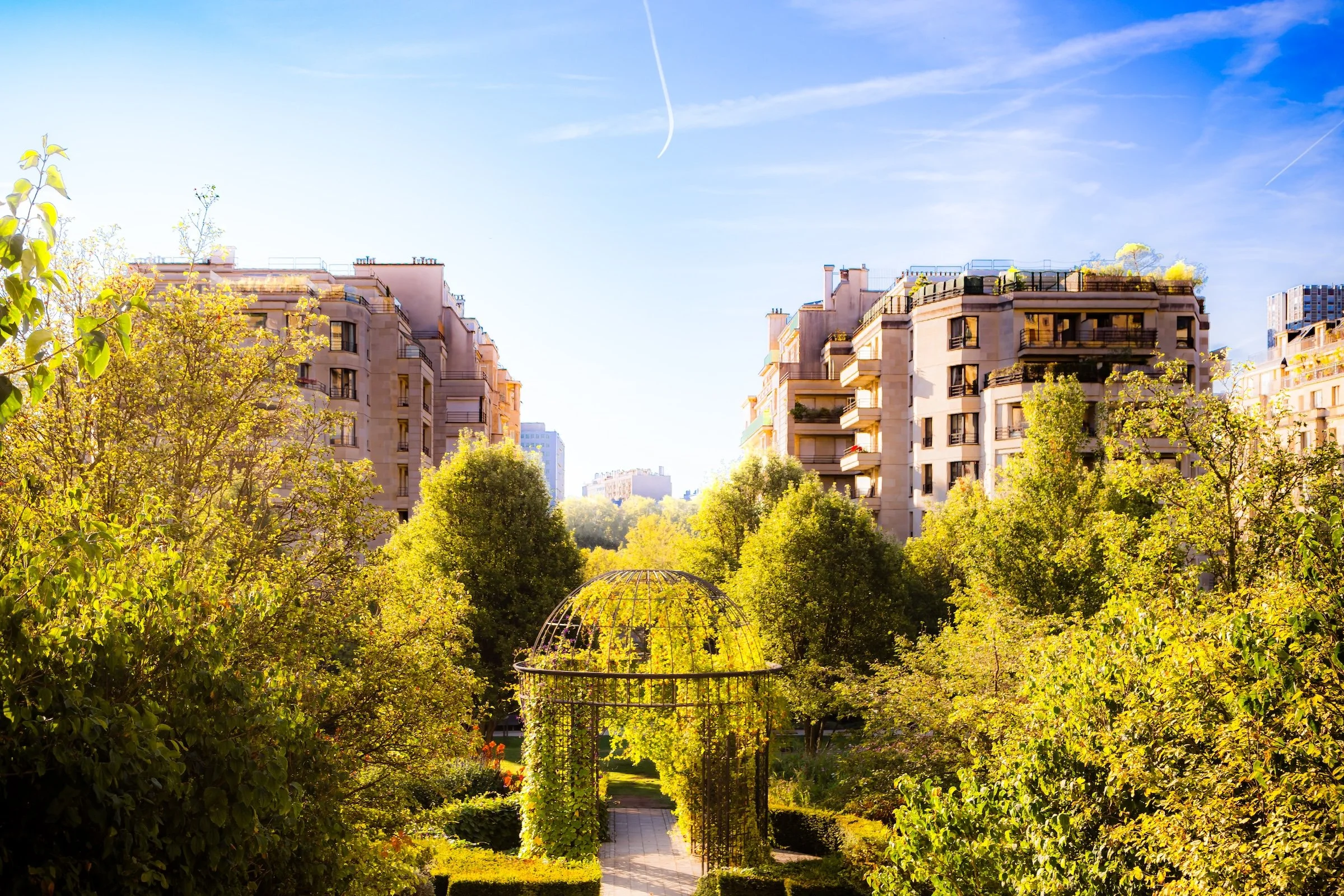
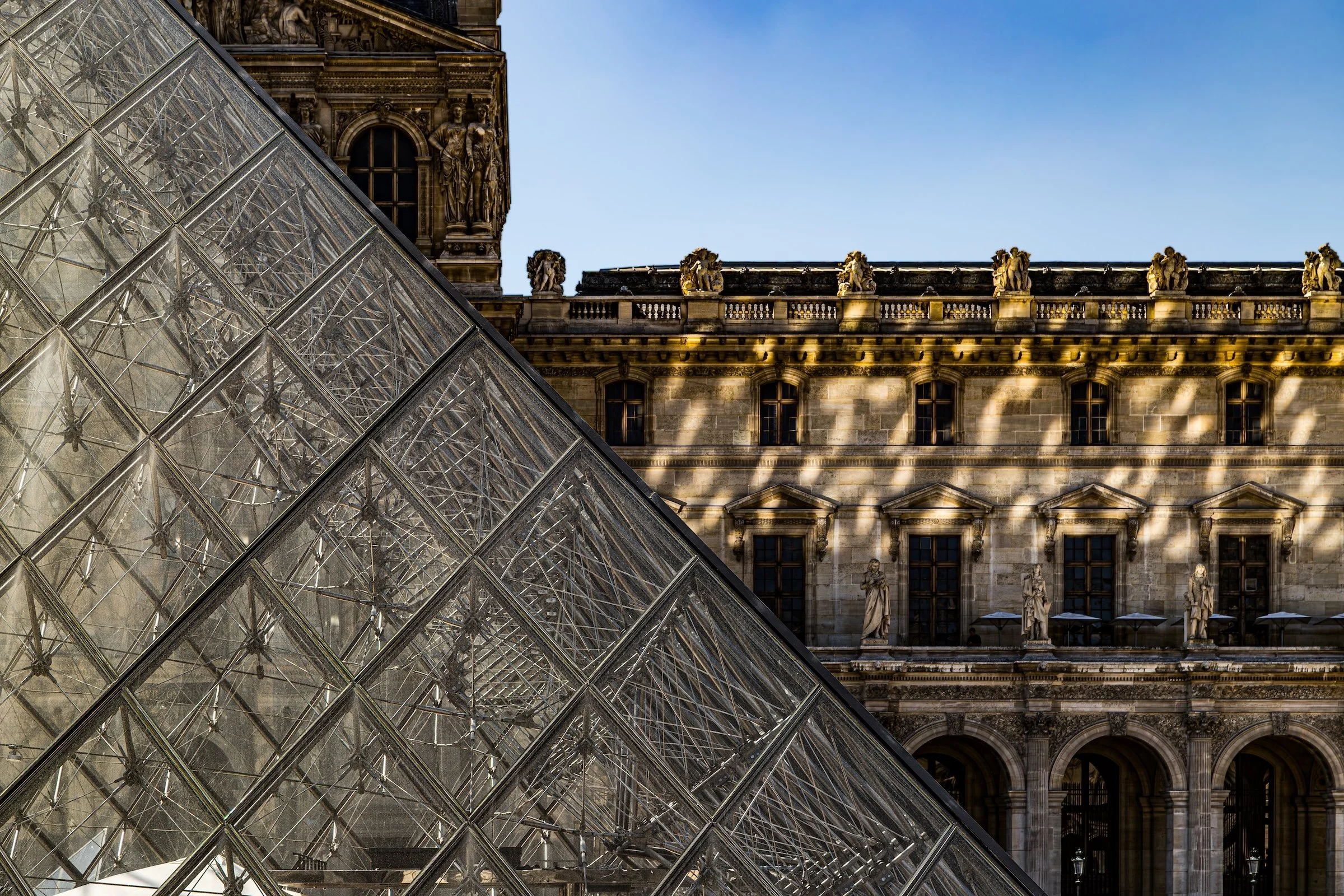
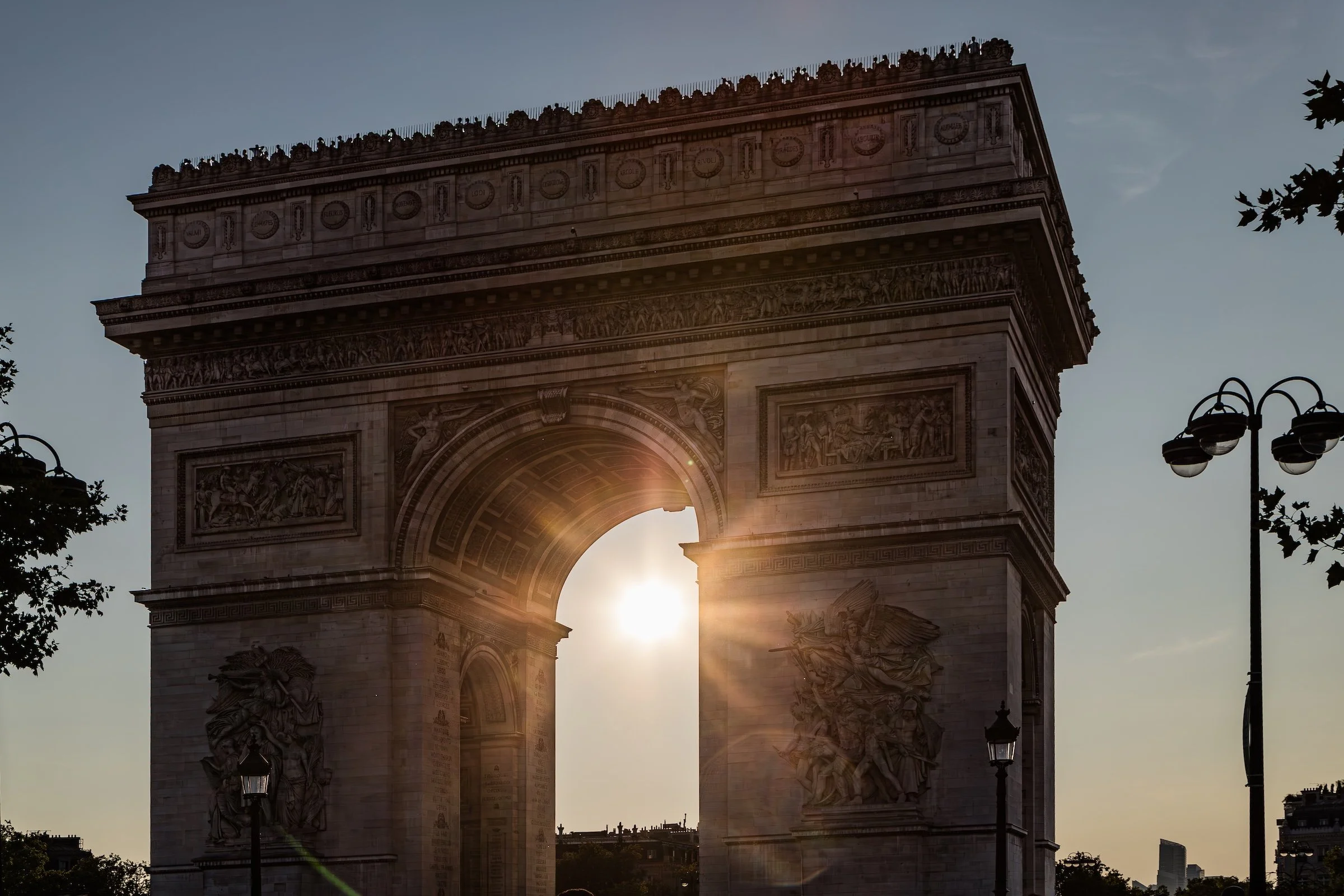
Faubourg du Roule: August 15, 2025
Faubourg du Roule Photo Gallery
Faubourg du Roule Flâneur Notes
-
19:42-19:55
Conditions: 32°C / 89°F | Humidity: 35%.
Faubourg du Roule was also encountered in the brief clockwise movement around the Arc de Triomphe. Like Ternes, it was touched at its outer edge, where the district meets the monumental choreography of western Paris. The Arc dominated the visual field, making it difficult to separate the quarter’s own identity from the grandeur of the circle and the avenues that radiate from it.
Yet even this limited passage gave Faubourg du Roule an unmistakable association with elegance, approach, and perspective. Its relationship to the Arc and the Champs-Élysées made it feel like part of the great ceremonial machinery of the Right Bank. The walk did not enter deeply enough to know the district, but it did enough to place it firmly on the future itinerary.
Other neighborhoods visited:
Flâneur Notes document the walks, photographs, light, and street-level observations behind this neighborhood entry. Learn more about the Spirit of the Flâneur.
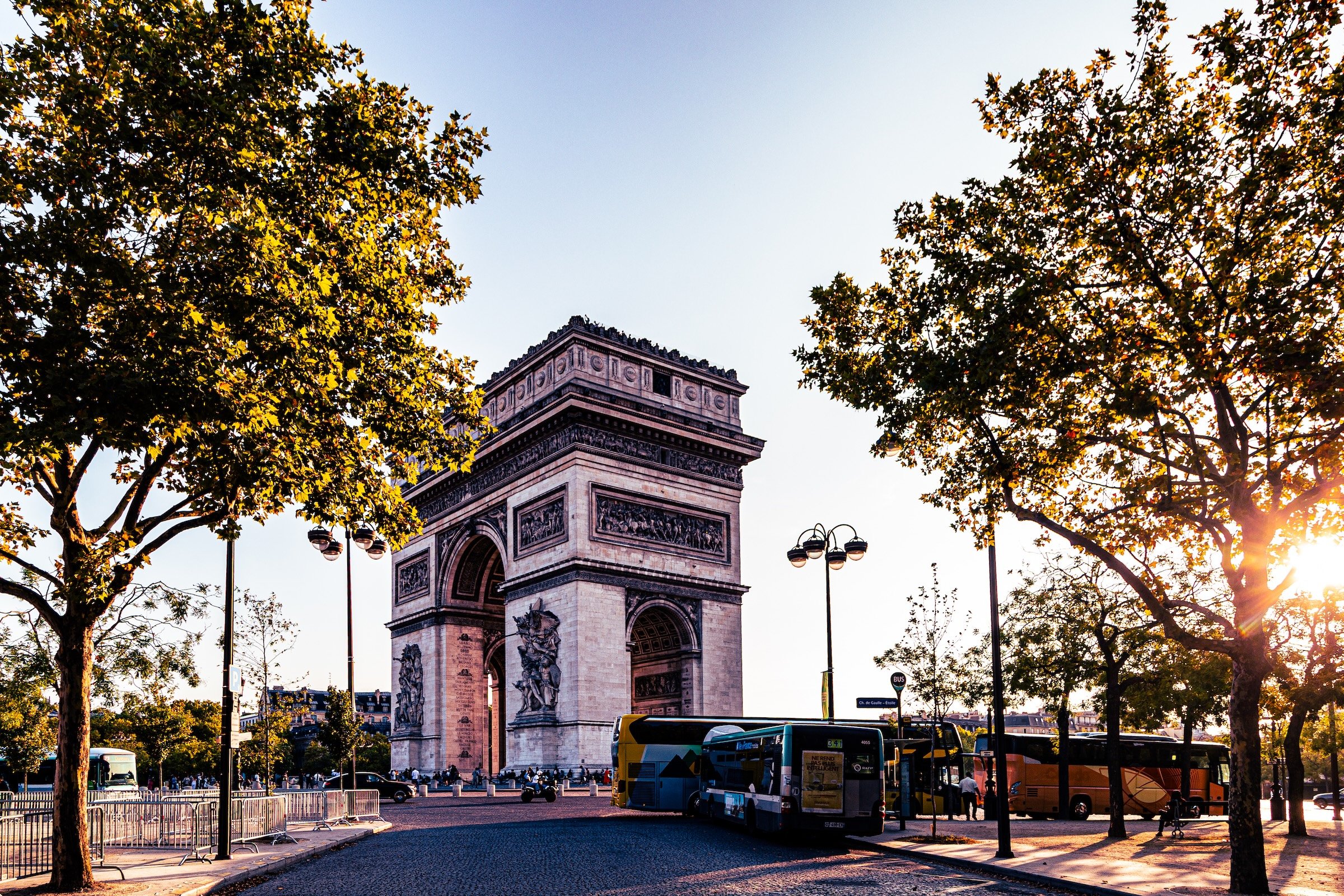
Explore Paris
-

The twenty arrondissements form the civic spiral of Paris, organizing the city into its broad local districts of government, identity, and daily life.
-
Each arrondissement is divided into four official administrative quarters, giving Paris a more precise civic and geographic framework.
-
The conseils de quartier bring participation to street level, giving residents a voice in neighborhood needs, public space, and local civic life.
-

Les Deux Rives trace Paris through the Seine’s two banks, revealing how the Rive Droite and Rive Gauche shaped the city’s civic power, commerce, learning, art, and cultural identity.
-
Cultural neighborhoods reveal the Paris people recognize through history, cafés, architecture, memory, atmosphere, and local belonging.